|
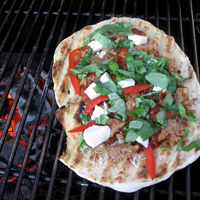
After you try pizza on the
grill, you may never go back
to the oven. Or the pizzaria.
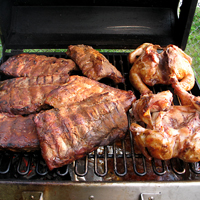
Enough food for 12 people
easily prepared in one afternoon
with less than a bag of charcoal
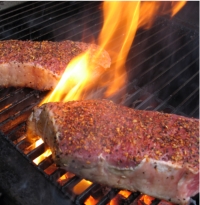
There's a lot going on here...
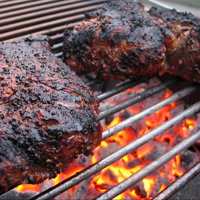
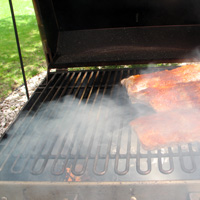
It's not burned.
It's Pittsburgh style.
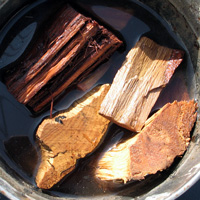
Think of the smoke as a
wonderful seasoning agent
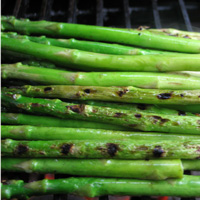
I think all vegetables should
be done on the grill!
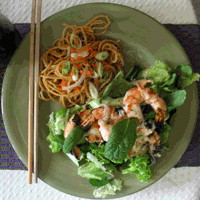
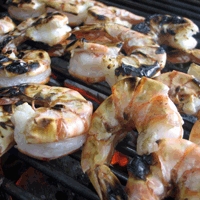
Thai shrimp salad. You can
do a lot more than burgers
with great equipment
|
Radiant Heat and the Lift Arm
As you may recall from high school physics,
radiant heat energy (infra-red) varies as the square of the distance from the source. (Another
of the many inverse square rules first formalized by Sir Isaac Newton.) This means that
as you change the distance from fire to food, the change in heat energy is much faster than the
change in distance.
For example, if you raise the coals from 8
inches below the food to 4 inches below, you would expect to get twice as much heat, but you
actually get four times the radiant heat energy. It's not a linear relationship.
Our B1 grill allows you to vary the heat
roughly 6x from the bottom of the stroke to the top. This is why we say you can give your food
a "blast" of radiant heat to brown, carmelize and generally take advantage of the mysterious
Maillard reactions ...
Fire and
Smoke
Once the magic starts, you need to stay in
control. The art of grilling is using high heat to char the surface of your food while controlling
how much heat is absorbed into the center.
(This is why a "Pittsburg" or "Black and Blue" steak is possible. Some of us
like the outside almost incinerated and the inside barely warm. Some of us think that's disgusting.
But nobody likes a tough, grey steak.)
You can't fully
control these variables, but it's really fun to try. This is the art of grilling. The B1
is the grill that will bring out the artist in you.
Suggestions: Raise the coals to make sure you
get browning on the surface, then lower the lever to get the food exactly how you like it cooked in
the center.
Don't be afraid to throw in some wood for a
live flame. Use a thermometer or master the "chef's touch" to see if a steak is done the way you like it. Don't nick the meat with a
knife. All the juice runs out. Master the touch or get a good digital
thermometer.
"Smoked" foods
The subject of smoking foods seems to break down into three general procedures
that are related, yet different. It's important to know the differences in terminology and
technique. These are all lower temperature, longer cooking time processes.
Cold
Smoking. True smoked foods, like fish, jerky, cheese and even oysters, aren't really
cooked by the process.You'll notice that most smoked food tastes salty. This is because the cold
smoke process does not get the food over the magic 140 degrees fahrenheit that kills pathogens --
the bad guys that can make you sick. So, although the smoke itself sterilizes partially, most
cold-smoked foods must be brined or pre-cooked before thay go into the smoker. The "smoking"
process really just adds flavor and dries the food.
Several of our customers swear that they make jerky and smoked fish on
their B1s, but we can't guarantee that you will get a true "cold smoke" with these
grills. You might be able to maintain the low temperatures (90 - 120° F) and you can
definitely generate the smoke, but there are better cold smokers out there.
Competition
BBQ. This is what we call the methods used by the hard-core competition barbecue circuit
fanatics (www.nbbqa.org). It's always "low and slow" cooking of cheaper cuts of meat for hours on end.
The equipment includes a bewildering array of homemade pits, side smokers and commercial
ovens that maintain a temperature of around 220 -240. But most of these teams use the same
heat source we do: charcoal and wood. So you can definitely make BBQ on our grill. It takes
attention, and time, but it's worth it. We have a few recipes on this website that can get
you started.
Remember that you are learning an ancient art. People have dedicated their
lives to figuring this out (check out a guy named Mike Mills) and there are huge competitions
with trained judges to make it official. Experiment. Go to a competition sometime. You'll
meet the nicest people on the planet and get to eat some amazing food. Sometimes there is
beer involved.
Barbecueing. Unlike the legends of BBQ, this is what most of us mere
mortals use our grills for. You want a temperature of 230 to 350 degrees and you cook larger cuts
of meat, like roasts, birds, ribs, etc.
This is what we at German Grill call "barbecuing". The temperature range is a
good tradeoff between meat shrinkage (the higher the heat the more shrinkage), cooking time
(ribs will take a few hours instead of all night), smokey flavor (keep adding smoke chips to
dose it with smoke early on), and tenderness (an hour wrapped in foil is equivalent to five
hours on a side smoker, and doesn't hurt the flavor at all, in my opinion).
|